

The physical space an individual occupies through their body is the only real birthright that individual is allotted in this world.

The respective proponents of many currently trending fitness practices claim the efficacy of their espoused modalities through some iteration of the usual tenets of efficiency and effectiveness. Rarely does such efficacy seem to be contextualized within a macroscopic perspective of the long-term functional conditioning of the practitioner’s body. As such, some fitness-oriented bodily movement practices, when practiced as methodologically prescribed, and when practiced consistently over extended periods of time (i.e. months, years), have been observed to ultimately undo the initially beneficial structural integration they inculcated within the practitioner’s physique. The fruit of the practitioner’s physical efforts eventually collapses upon itself, to the detriment of the practitioner.
The efficacy of a bodily movement practice should be subsumed under its longevity. That is, its ability, over time (both long-term and short-term), to condition an individual’s physicality toward functional strength, and a functional range of motion; that translate easily to that individual’s everyday movement patterns, whilst mitigating the negative effects of those same everyday movement patterns. A bodily movement practice has longevity if it efficiently addresses the day-to-day functional movement needs of an individual; through movements that complement daily movement patterns; through movements that mitigate bodily ailments that are caused by, and/or related to, those daily movement patterns; and through movements that seek to correct (possibly) inhibited or dysfunctional movement patterns caused by bodily trauma (e.g. an old bodily injury) or some other bodily dysfunction (e.g. excess tension, chronic pain). Further, such a practice should neither hinder an individual’s long-term fitness progress, nor render an individual unable to perform regular everyday activities (e.g. walk, run, carry groceries) they would otherwise normally be adept, or competent, at.
A bodily movement practice maintains its efficacy, and thus, its longevity, through functionality; it must serve, and support, an individual’s daily movement needs and growth in movement skill. An individual should not have to chronically inhibit or deter their choices of (low risk) physical activities that accompany their functional daily lives, because the risk for overwork, and injury, within such a practice should be low. A practice of this kind enables the individual an opportunity for actual re-patterning of their body, so that their bodily movements make biomechanical sense. This physiological efficiency might help them achieve some sort of bodily holism.
Since the longevity of a practice is necessarily reliant on the functional condition of the practitioner’s body, an efficacious approach should focus on the practitioner’s ability to safely continue the practice as they age. This necessitates biomechanically-sound movement patterns – intelligent, and anatomically-safe movement patterns that condition, and inculcate, within the individual’s body, an adept ability, and adaptability, for subsequent movement patterns of increased complexity. A biomechanically-sound movement pattern should, ideally, transcend the codifications and distinctions of the various movement modalities, and any movement pattern that does not meet the criteria of being biomechanically-sound should be discarded. Further, an efficacious approach should also be characterized by a disciplined open-mindedness toward progressive modification of the practice, so as to best serve the needs of an individual’s current daily life (even as their daily life and needs change with time).
Potency, and level of difficulty, are subjective; their respective definitions (regarding a bodily movement practice) vary respective to each and every individual; their respective definitions also fluctuate with regard to a single individual, from one day to another, and (perhaps more significantly) over the entire course of that individual’s life with that particular movement practice. An efficacious approach should nurture a cognizance, and encourage an exhaustive exploration, of its practitioner’s evolution and needs.
The physical space an individual occupies through their body is the only real birthright that individual is allotted in this world; and, since continual growth requires positive stress, there is nothing inherently wrong in seeking to push the limits of a bodily movement practice. Yet, such striving should not end up inaccurately circumscribing the physical space that the practitioner, by birthright, should occupy. The longevity of a physical movement practice depends on how precisely it is able to delineate its practitioner’s unique physicality.
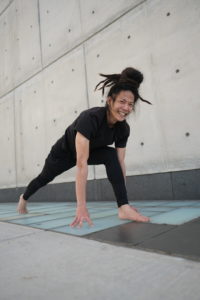 Justin is a Sculpt, Barre, and Yoga teacher based in New York City. Various nerve injuries, debilitating chronic pains, and postural problems, led him to yoga and pilates; which profoundly impacted his body and mind. Cognizant of the relation between the physical, psychological, and emotional, Justin has a deep love for creative yet sound movement patterns that nurture proprioception and mobility, cultivate strength and balance, and instill fluidity and adaptability.
Instagram: @fluiddynamix
Photo Credit: @reneechoiphotography
Never Miss a Post!
The Top Three Reasons for Joining NJYC
The greatest teachers, studios, classes and communities are in the Garden State.
You are ready to inspire and be inspired.
You believe in living a life you love, supported by a practice that makes you feel amazing

